

Clinical Language in the Workplace
Leadership today is being stretched beyond recognition.
In various industries, leaders are now expected to do more than drive performance, manage
conflict, and build teams. They are also increasingly looked to for understanding personal
struggles, regulating emotional climates, and addressing psychological language that previously belonged to clinical or professional support areas.
The intent behind this shift is understandable. Organizations want more humane cultures. People desire to be seen, supported, and appreciated. Many leaders are naturally empathetic and truly care about their teams’ well-being. “Know your people and promote their welfare” is a leadership principle we must follow. However, over time, leadership has increasingly been viewed as a universal solution to all human challenges.
We are slowly medicalizing leadership.
Terms from clinical psychology, like trauma, depression, and anxiety, are increasingly appearing in leadership discussions. These are significant issues that affect many individuals and require careful attention, expertise, and proper care. However, when such language is used in leadership settings without clear boundaries or distinctions between mental health and mental illness, it can cause role confusion. Leaders may start to believe they are responsible not only for performance and safety but also for psychological assessment and emotional healing.
There is an important distinction that often gets lost. Supporting mental health is not the same as managing mental illness.
Leaders should absolutely create psychological safety where people can speak up, recover,
perform, and access support. They should know their people. They should care. They should
build trust, cohesion, and morale. In high-performing teams, connection and accountability
coexist, and compassion is not optional.
But clinical disorders require clinical training, scope of practice, and responsibility. When we
blur that line, we do not make leadership more progressive. We make it more uncertain. Leaders are not immune to what they are exposed to. Many operate in environments where stress, adversity, and difficult realities are already part of the job. When we expand leadership expectations to include holding space for others’ trauma without appropriate training or support, we must also consider the impact on the leader.
Not every leader has processed their own experiences. Not every leader has the capacity, in that moment, to absorb the weight of someone else’s. Without structure, support, and clear
boundaries, we risk asking leaders to carry more than they are equipped to hold.
After spending the last two years studying psychology at the graduate level, I find myself more cautious about how easily we use clinical language in leadership. The deeper you go into understanding trauma and psychological injury, the more you appreciate their complexity. These are not concepts to be simplified into management frameworks or leadership slogans.
In high-pressure environments where results matter and consequences are real, hesitation can be costly. Leaders are already balancing safety, workload, operational demands, team dynamics, and organizational expectations. Adding unbounded psychological responsibility without clear guidance or support does not create better leadership. It creates structural overload, ambiguity and a burden leaders are not clinically trained for.
There is also a hidden dynamic emerging.
Modern leadership expectations are increasingly shaped by content that spreads faster than
experience. Followers are consuming messages about what “good leadership” should look like, often framed in idealistic or therapeutic language. This influences how they measure their leaders. Frontline leaders in industries such as energy, healthcare, law enforcement, sport, and manufacturing are now being evaluated not only on outcomes, but on whether they meet evolving emotional and psychological ideals.
Many of these ideals sound compelling in theory. In practice, they can be extremely difficult to sustain without time, resources, training, or authority.
The result is frustration on both sides. Leaders feel they are failing despite working under
immense pressure. Teams feel unsupported when leaders cannot meet expectations that were never realistically defined. Organizations respond by adding more leadership language rather than clarifying leadership responsibility.
What we need is not less humanity in leadership. We need more clarity.
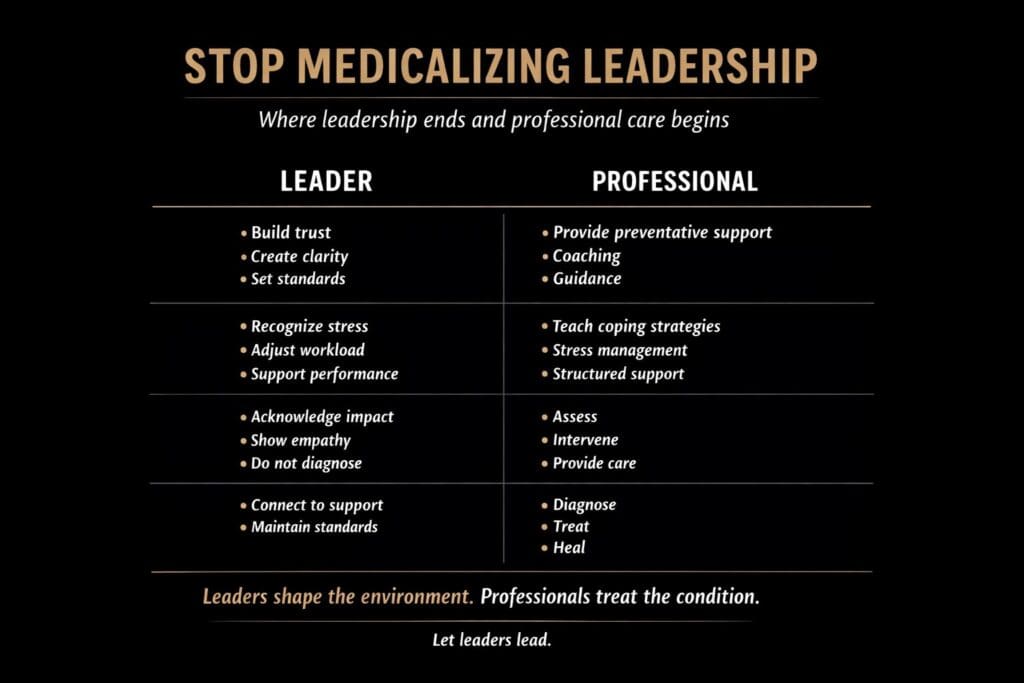
Stress-informed leadership offers a more grounded path forward. It acknowledges that pressure affects behaviour. It recognizes that fatigue, overload, fear of failure, conflict, and uncertainty all shape performance. It encourages leaders to create predictable environments, hold standards, and connect people to appropriate support when challenges exceed their scope.
This is not about reducing care. It is about strengthening leadership effectiveness while
protecting both leaders and teams from unrealistic assumptions.
Leadership was never meant to replace families, communities, clinicians, or support systems. It plays a critical role in shaping culture and performance, but it cannot carry the full emotional and psychological weight of modern work.
If we want leaders to care for others, we also have to care for the leader. If we want healthy
organizations, we must include the leader in our circle of care. Give leaders clarity. Give them
support. Give them boundaries. And let them lead.
About the Author
Justin Yaassoub is the founder of All Around Performance and a trusted leadership advisor for high-risk and high-performance environments. With over a decade of experience in emergency response, tactical leadership, and organizational development, he brings a grounded, no-nonsense approach to developing resilient teams. Justin has taught leadership strategy at institutions like NAIT’s Centre for Applied Disaster and Emergency Management and continues to work directly with frontline and executive leaders across Canada.
Continue Learning
🔹 Explore our leadership training programs
🔹 Learn more about our Experiential Leadership Events
🔹 Book Justin for your next Keynote


